A few days before the premiere of (What You’ll Find) On the Way to Becoming, I attended a rehearsal in Zurich (thank you, Meloe). The rehearsal took place at Schauspielhaus Zürich, one of Switzerland’s largest publicly funded theatres and one of the most influential stages in the German-speaking world. For readers outside Europe, that detail matters. Work presented here does not sit at the margins. It enters the centre of cultural life, a space where theatre engages directly with questions of public responsibility, social change, and who is being addressed, and how. What I encountered that evening did not feel like a production preparing itself for opening night. It felt like a work still listening.
Performers moved between dialogue, music, stillness and repetition. The stage suggested a nightclub more than a proscenium: bodies gathering and dispersing, sound shaping the room, moments allowed to breathe rather than resolve. The atmosphere was attentive, alert and unforced. Even in rehearsal, it was clear that this was not “just a play” organised around plot points or dramatic escalation. It was built around something quieter and more demanding: how people share space with one another. There was no sense of the work performing for approval. Instead, it seemed to be testing conditions: how much time could stretch, how stillness might be held, how an audience might be invited in without being instructed. What stood out was not polish, but intention.
Two days after the premiere, I sat down privately with the makers of the work, Talia Paulette Oliveras and Nia Farrell, the New York and Los Angeles–based theatre duo who work together as Ta-Nia. By then, the piece had only just begun its public life in Zurich, Switzerland of all places. It had met its first audiences, absorbed their presence, and begun to shift slightly from night to night. It had crossed a threshold, from internal listening to public encounter.
Our conversation took place at that early moment, after first contact, before distance or categorisation had settled in. We did not speak about reviews or reception. We did not dissect responses or measure success. Instead, we spoke about how they work, why they work this way, and what it means to invite people into a shared space without telling them who or how to be. We spoke about attention, responsibility and trust: not as abstract ideas, but as practical choices that shape how a room feels, how people move within it, and what becomes possible between strangers.
Who Ta-Nia are, and how their collaboration took shape
Ta-Nia is not a production label or a loose collaboration. It is the shared artistic practice of Talia Paulette Oliveras and Nia Farrell, two artists whose paths crossed while studying theatre at NYU in New York, but whose collaboration only began years later, once each had developed a clear sense of what they wanted theatre to be for.
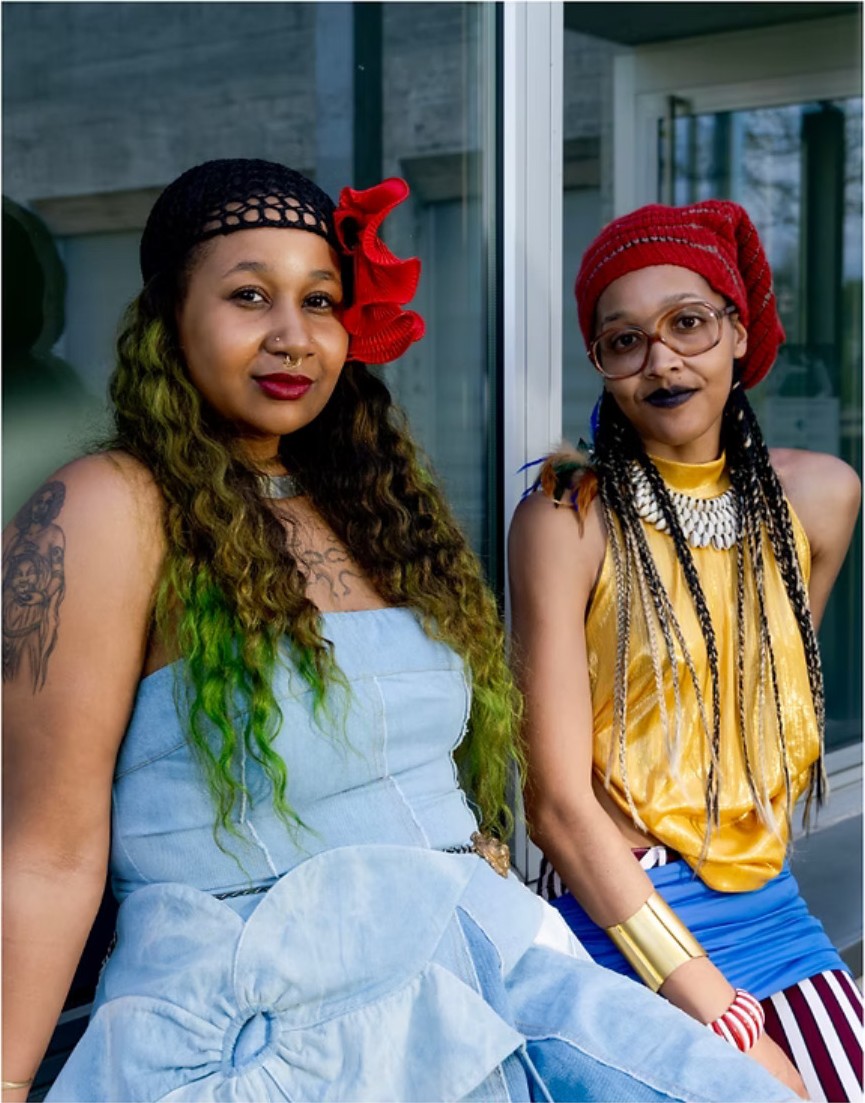
That delay matters. Their partnership did not emerge from proximity or convenience, but from mutual recognition. They watched each other’s work over time, noticed how their questions aligned, and waited until the conditions felt right. When they finally decided to work together, they describe the moment with a striking softness, less like forming a company than like making a personal proposal. Intentional. Relational. Unhurried. That way of beginning flows through everything they create together.
Nia Farrell: ritual, imagination and near-futures
Nia Farrell comes to theatre as a writer, performer, and what they call a mundane Afrofuturist. Their work is rooted in speculative thinking, but not in distant or abstract futures. Nia is interested in near-futures: possibilities that begin in the present, shaped through imagination as a practical, collective muscle. On stage and screen, Nia’s work often centres ritual as a way of honouring Black life not as trauma or metaphor, but as lived, dreaming, future-oriented reality. Their performances invite audiences to rehearse different ways of being together, not by explaining those futures, but by briefly inhabiting them.
Alongside experimental theatre contexts such as National Black Theatre, Ars Nova, Second Stage Theater and Williamstown Theatre Festival, Nia also works within mainstream production structures. As Director of Development and Production at Nine Muses Entertainment, founded by Bryce Dallas Howard, they support projects across film and television, including collaborations connected to Disney+ and Imagine Docs. That dual position shapes how Nia understands institutions: how to navigate them, when to push against them, and when to use their resources without being shaped by their expectations.
Talia Paulette Oliveras: theatre as space, theatre as care
Talia Paulette Oliveras approaches theatre as a space of potential, an ever-evolving “now” where story, body, memory and presence intersect. Of Dominican and Puerto Rican descent, Talia’s artistic practice is inseparable from their work as a community healer, and from spiritual lineages inherited through their grandmothers, who served their communities as caretakers and healers. Alongside formal theatre training and work with institutions such as the Brooklyn Academy of Music (BAM), Ars Nova, The Public Theater, The Shed and the experimental company Mabou Mines, Talia has trained in Reiki, herbal medicine, trauma-informed care and healing justice, and has organised with grassroots movements focused on mutual aid, food sovereignty and community defence.
This background is not an add-on to their theatre work. It is foundational. For Talia, theatre is not primarily a vehicle for representation or storytelling, but a way of shaping spaces where people can be present with themselves and one another, without having to justify that presence.
A shared lineage, a shared method
Both artists come from experimental theatre traditions in the United States, particularly those shaped by Black performance histories. In these traditions, theatre has often functioned less as display and more as gathering: a place for repetition, ritual, humour, grief and collective processing. Story matters, but it does not dominate. What matters equally is how people are brought together, and what becomes possible once they are. That lineage is present in the piece not as reference or quotation, but as structure. The work does not ask what the audience should understand. It asks what the audience might experience together, and then builds patiently toward that experience.
This commitment to theatre as a practice of gathering rather than instruction is what gives Ta-Nia’s work its clarity. And it is what makes their arrival in Zurich feel less like a one-off production and more like a meaningful encounter between artistic worlds.