Who Gets to Say «Colonialism»
On 15 October 2026 a UN committee voted that colonialism survives in new forms. The «no» votes follow today's alliances. The rest of the room follows older maps, and in places breaks them.
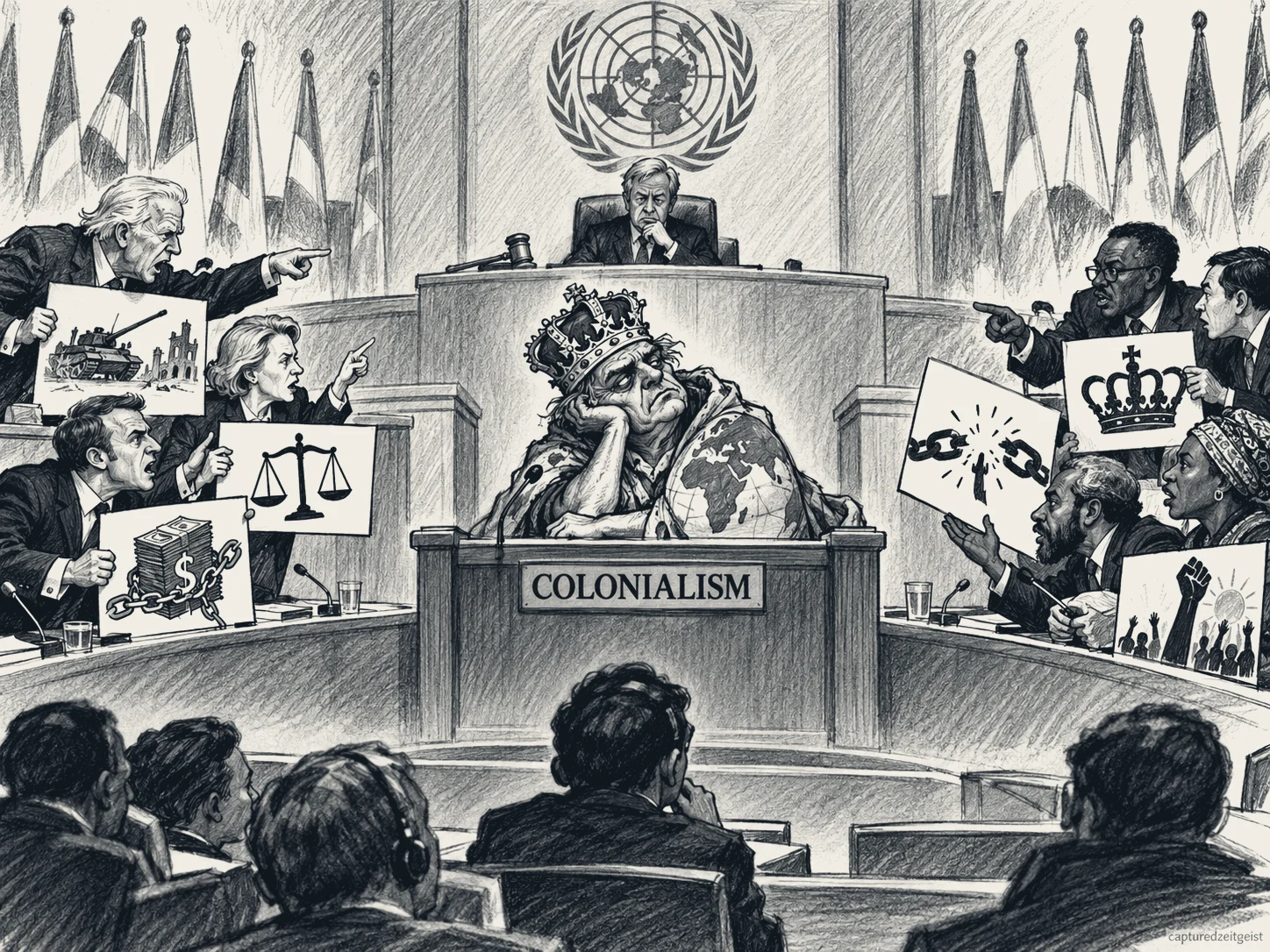
The text passed the Fourth Committee 85 to 49, with 23 abstentions and 36 members not voting. The same morning, the general decolonisation text passed 120 to 3.
OFFICIALThe «no» column is the Western alliance system almost exactly. 48 of the 49 come from the EU, NATO, the EU candidates, Washington's treaty partners in Asia-Pacific and the rest of the UN Western group. Ecuador is the one clear outlier.
PROVISIONALInside those circles, 48 of 56 states voted no. Outside them, 1 of 137 did. Alliance describes the «no» column far better than colonial history does.
PROVISIONALColonial history matters more in the spread of yes votes and abstentions, and in why the European Union could not carry the formerly colonised with it. But 59 of the 85 yes votes cannot yet be named, so that reading stays provisional.
OPINIONForty seven of Africa's 54 votes are not yet individually verifiable. A news report of the voting board records no vote at all for Nigeria.
DATA GAPOFFICIAL means published by the UN. PROVISIONAL means names not yet in the UN's country by country record. OPINION marks our judgement. Hover or tap any dotted term for a definition.
On the morning of 15 October 2026, in a committee room in New York, the United Nations voted on whether colonialism is over. Not in those words. The draft, A/C.4/81/L.5, was titled «Addressing contemporary forms of colonialism», and it asks the General Assembly to recognise that colonialism persists «in contemporary forms and practices in relations among States». The Fourth Committee approved it by 85 votes to 49, with 23 abstentions.
The count is the story, more than the text. Decolonisation resolutions usually clear this committee with a handful of votes against. That same morning, the general text on implementing the 1960 Declaration passed 120 to 3. This one split the room. And the split did not run cleanly between former empires and the formerly colonised. It ran through both.
The draft was introduced by Russia on behalf of the Group of Friends in Defense of the Charter of the United Nations. That fact shapes everything that follows, and we will not pretend otherwise. But a vote is never only a verdict on its sponsor. It is also a map of who believes what about power, and that map has a genealogy. This essay follows it: where the word «colonialism» came from in UN law, which lines drawn in 1960 still hold, which have broken, and where we, writing from Switzerland, stand in all of it.
What the text says, and what it does not
The text gives examples. Colonialism in contemporary form, it says, may be expressed through unilateral economic, financial or trade measures not in accordance with international law and the Charter; through the threat or use of force against a state's territorial integrity or political independence; through interference in internal affairs; and through restrictions on access to markets and services. Its sponsors present it as a call for international cooperation to reduce structural inequality.
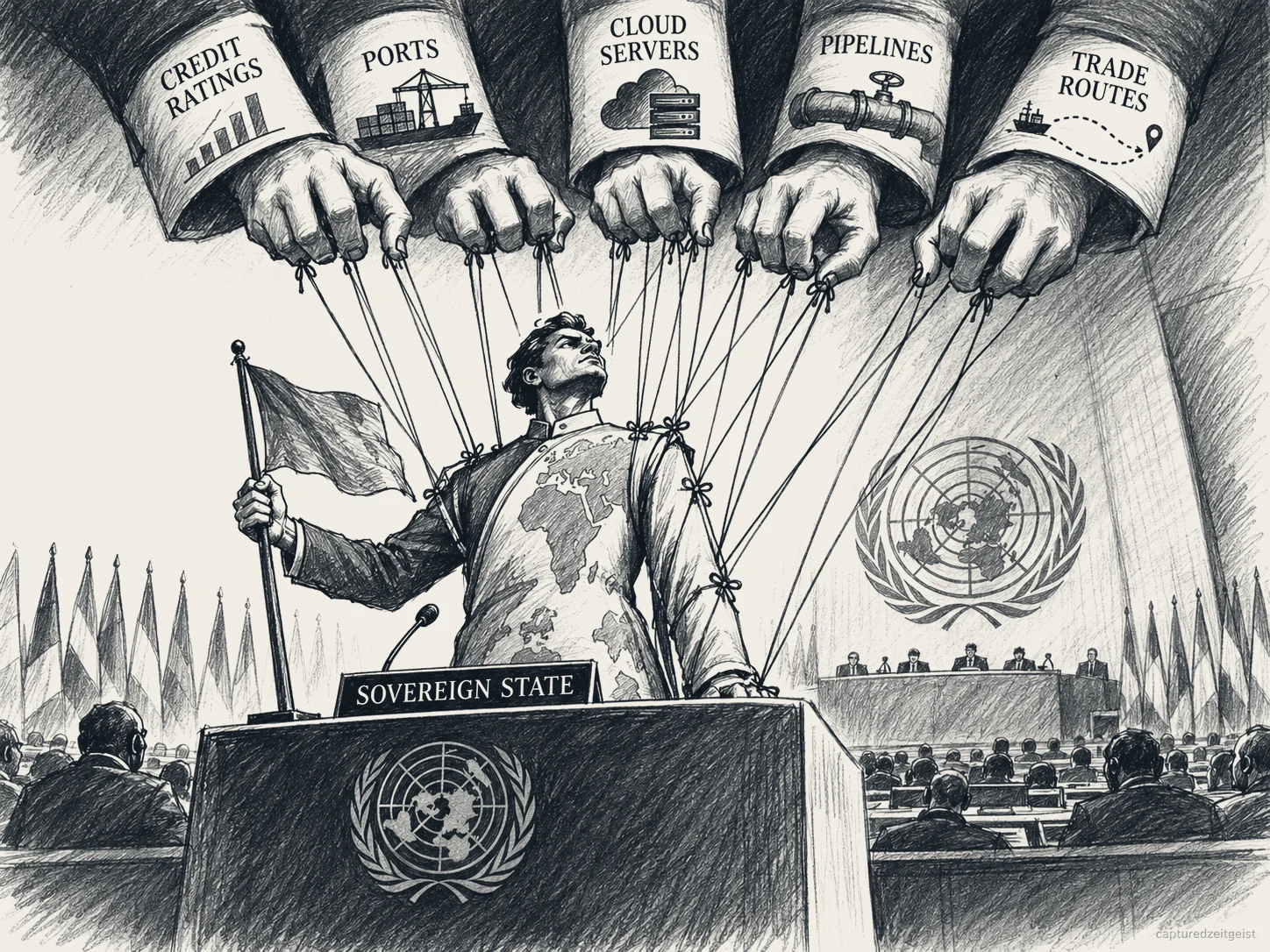
What it does not do matters as much. A committee vote is a recommendation. The General Assembly takes up the Fourth Committee's drafts in plenary, normally in December, and even then a resolution of this kind binds no one. Its force is the force of a record: who stood where, on which words, in which year. Records are what genealogies are made of.
Sanctions are not one thing+
A word under strain+
Which names we can stand behind+
«Colonialism has not disappeared; it has adapted.»
Fifteen October, country by country
Click any country for its vote, its alliances and the colonial history behind it. Switch the colouring between VOTE, ALLIANCE, HISTORY and SANCTIONS, and watch which patterns survive each switch. TILES gives every state one equal square, because every state has one vote. TABLE lists all 193 and downloads them.
Four readings sit on top of each other. Coloured by vote, the «against» column is Europe, North America, Australia, New Zealand, Japan and a few Pacific states. Coloured by alliance, it is almost exactly the European Union, NATO, the countries queuing to join the EU and Washington's treaty partners in the Pacific. Coloured by history, the same column holds almost every former overseas empire, and also Ireland, Malta, Cyprus, Estonia, Ukraine and Georgia: places that were themselves ruled from somewhere else. Coloured by sanctions, every sanctioned state with a named vote voted yes.
OPINIONAlliance explains the «no» column. History explains more of the rest. Self-interest explains part of the «yes». None of the three explains the vote alone, and that is the most important finding on this page.
Testing the obvious explanation first
Before reading a colonial genealogy into this vote, we owe it a simpler test: do the «no» votes simply follow today's alliances? On the provisional names, almost perfectly.
Inside the five circles, 48 of 56 states voted no, and two, Thailand and the Philippines, are reported in favour. Outside them, 1 of 137 voted no: Ecuador.
Its edges: Serbia, the Republic of Korea, the Marshall Islands and Palau sit inside Western relationships and abstained. Turkey and Bosnia and Herzegovina sit inside them too and are not among the 49.
A rule that says former empires, administering powers and settler states vote no captures 15 of the 49 «no» votes.
It also misfires on 6 of the 21 such states with a named vote: Russia voted yes, Brazil, South Africa and Uruguay are reported yes, and Argentina and Chile abstained.
OPINIONSo the honest version of this essay's argument is narrower than its first draft. Alliance tells you who said no. History helps explain why so many formerly colonised states said yes or abstained, and why the European Union could not carry them. We keep the genealogy because the vote's meaning is historical, not because history predicts it.
Circles are applied in order, so each state counts once: EU; NATO outside the EU; EU candidates outside NATO; US treaty allies and Compact of Free Association states in Asia-Pacific; the rest of the UN Western European and Others Group. Our coding, from EU, NATO and UN membership lists.
One hundred and ninety three seats
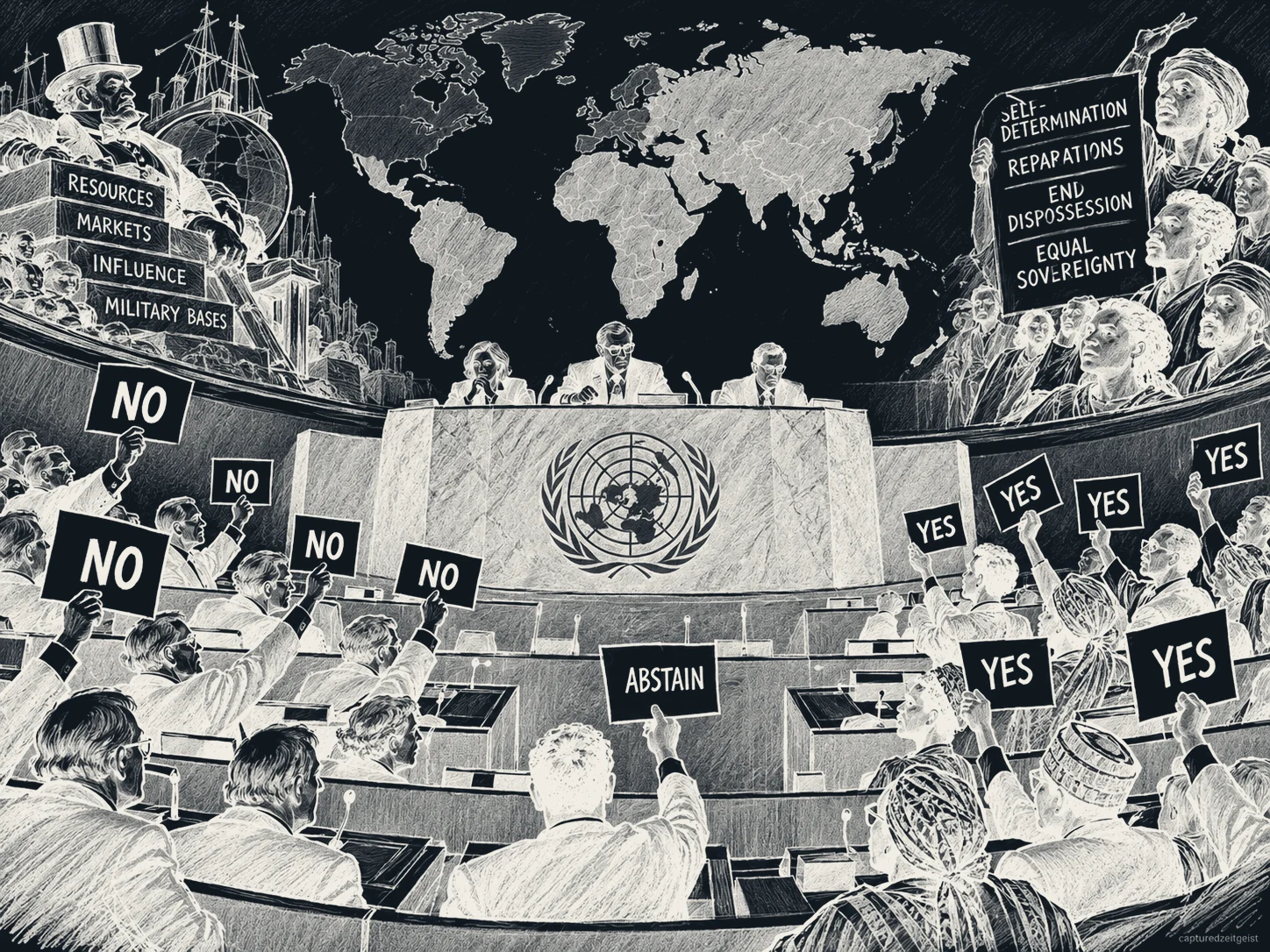
Thirty six members did not vote at all. The margin between yes and no was also thirty six. In a room that close, absence was a position too.
Africa's 54 seats are still mostly grey: 47 of its votes cannot yet be named. One news report says most of Africa voted yes; the UN has not yet published the names. Group sizes follow our dataset; official group lists differ by one or two because of observer and dual memberships.
In these six texts across sixty six years, the «no» column never held more than six states until 15 October, when it held forty nine. Compared with the same morning's Declaration text, thirty five votes left the «yes» column once the subject moved from territories to trade, finance and sanctions.
Bars are shares of all UN members at the time: 99 in 1960, 138 in 1974, 193 since 2011. The outlined remainder did not vote. A selection, not a complete series; the full annual record is in the UN Digital Library.
Two family lines, one vote
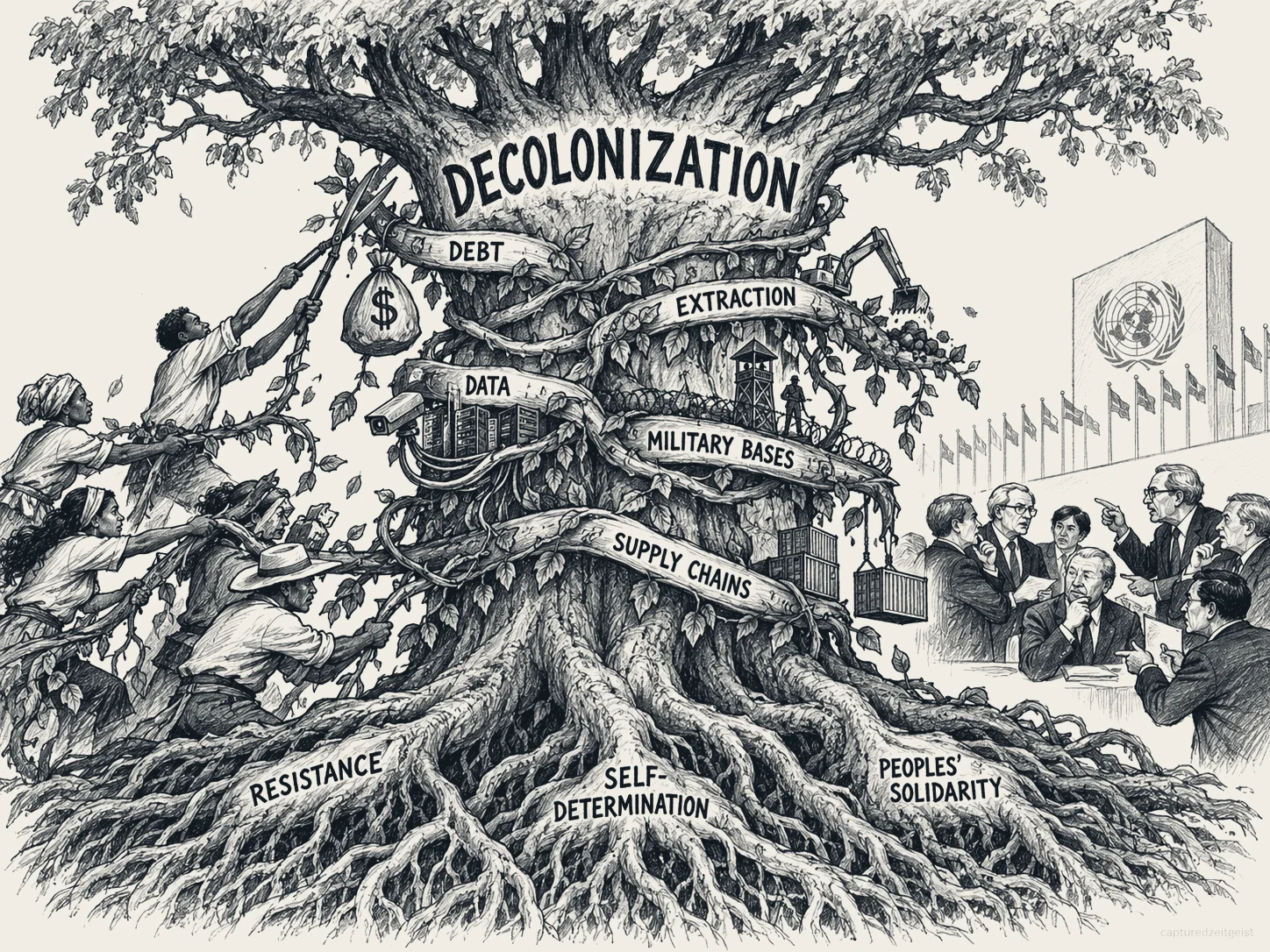
In the early 1950s a State Department memo warned that colonialism had become «as dominant in the United Nations as the East-West conflict». Seventy years later the two have fused into a single roll call. To see how, it helps to follow the word «colonialism» down two family lines.
One line is territorial. It asks who governs a place, and it built the UN's decolonisation machinery. The other is economic. It asks who decides a country's choices once the flag has changed, and it produced the vocabulary of neo-colonialism, coercion and structural inequality. For sixty years the two lines ran side by side. On 15 October they met in one text, and the room split along the seam. Open any entry for its detail and its primary source. The two line model is our reading, drawing on historians of anti-colonial internationalism such as Adom Getachew and of the mandate system such as Susan Pedersen. It is a lens, not a law.
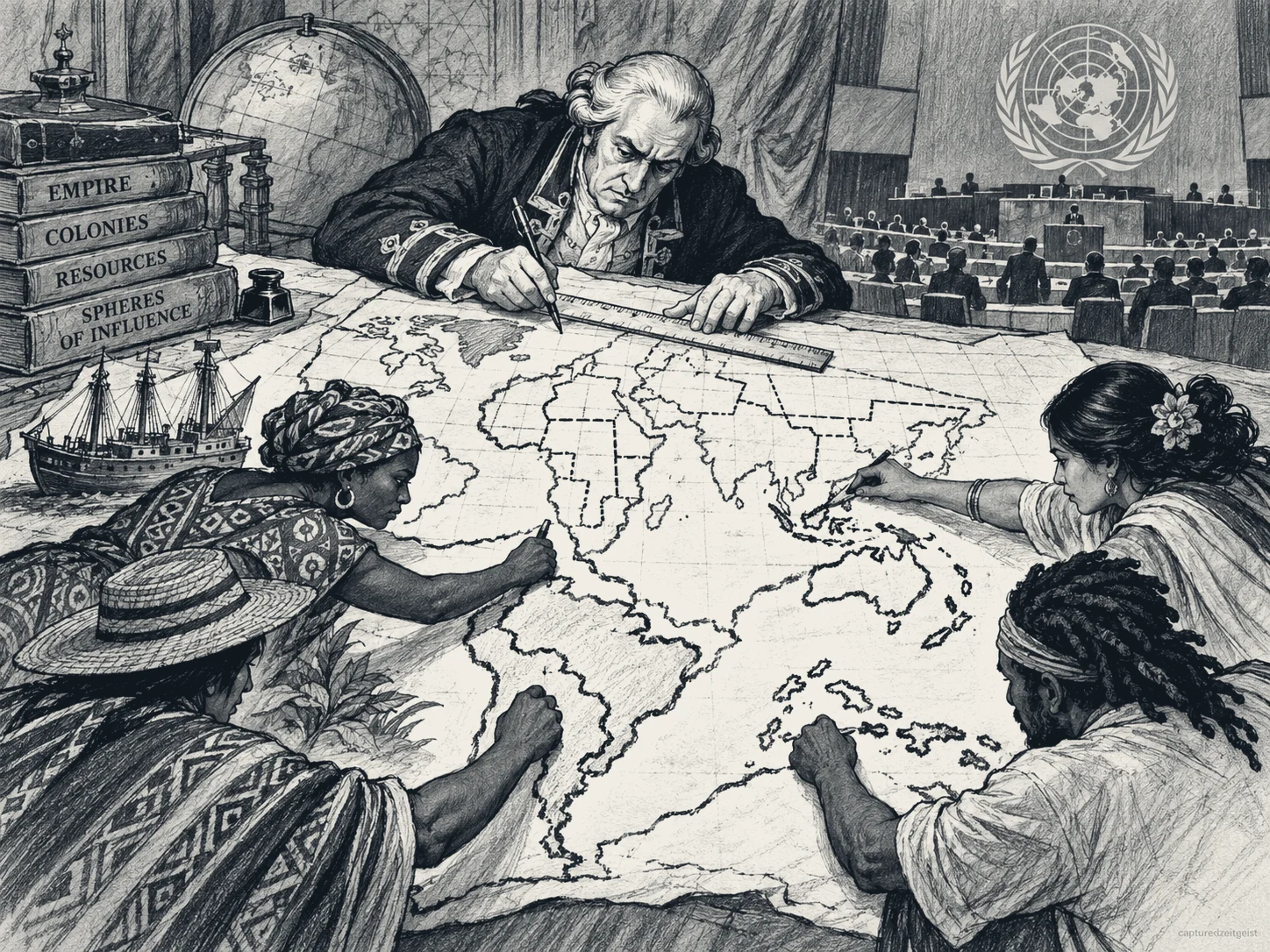
1884Berlin sets the rules for claiming Africa+
1919The «sacred trust of civilisation»+
1945Chapter XI of the UN Charter+
1960Resolution 1514, the Declaration+
1960Resolution 1541: three ways off the list+
1961The Special Committee, later the C-24+
1990A decade to end it, then three more+
1994The last trust territory+
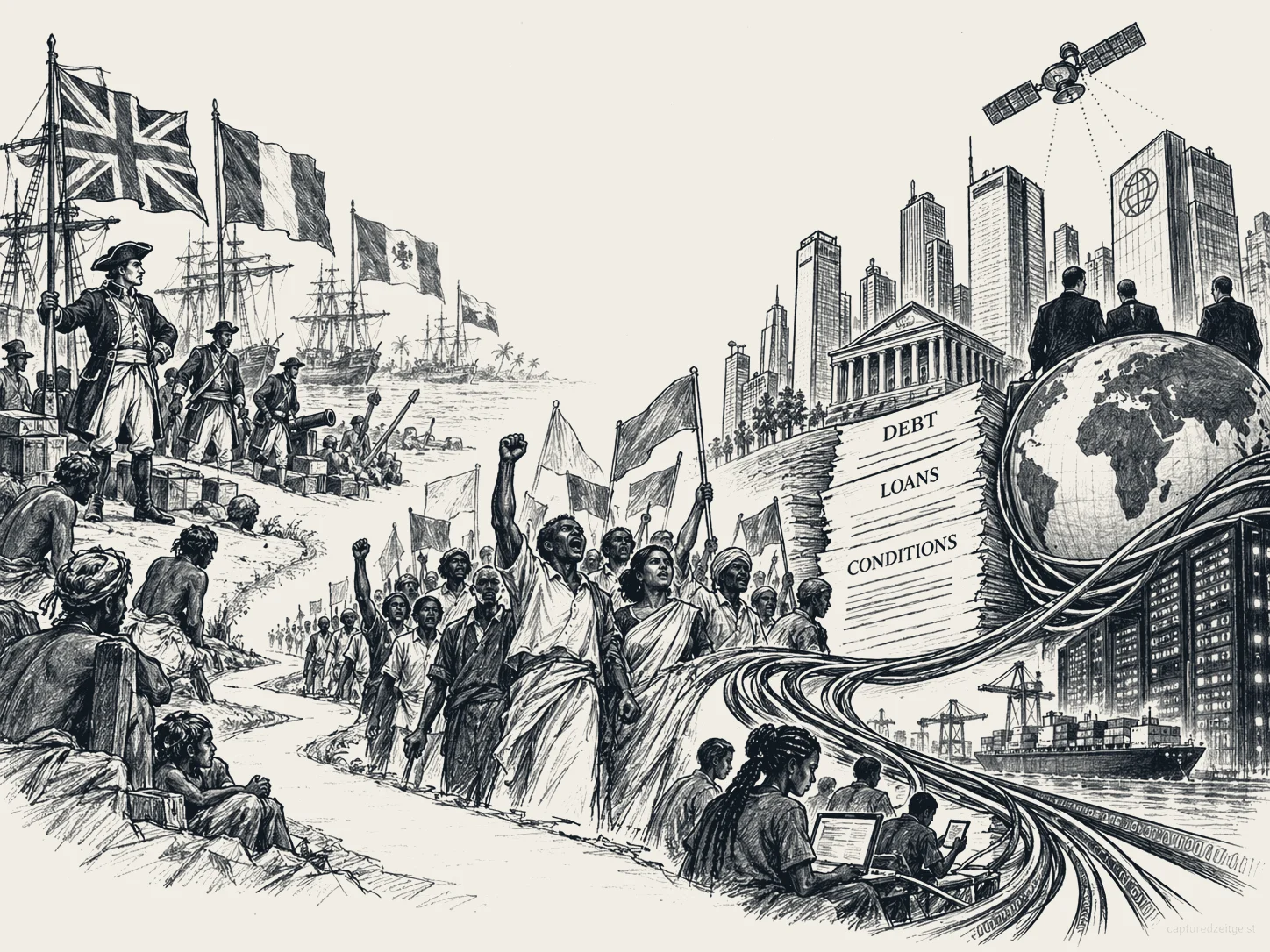
1955Bandung: «in all its manifestations»+
1961Non-alignment, in Belgrade+
1965Nkrumah names neo-colonialism+
1970A rule against coercion, agreed by all+
1974A new economic order, and six «no» votes+
1990s«Unilateral coercive measures»+
A/C.4/81/L.5 takes coercion, market access and structural inequality from one family and names them with the other family's word: colonialism. On territory, the morning's vote was 120 to 3. On this, it was 85 to 49. The seam is where the room split.
Nine abstentions, sixty six years later
When Resolution 1514 passed in 1960, no state voted against it. Nine abstained. Here is how the same nine voted on 15 October, on the provisional record.
Seven of the nine said no. The Dominican Republic, a dictatorship under Rafael Trujillo in 1960, abstained again. South Africa, an apartheid state in 1960, is reported among the yes votes in 2026. That row is the reminder this whole map needs: a state's vote follows its government and its people, not its borders.
From fifty one members to one hundred and ninety three
Press play. Countries light up in the year they join. Nearly three in four of today's members joined after 1945, and seventeen joined in 1960 alone, Nigeria among them. The Assembly that will vote on this text in December is, in large part, the product of the decolonisation it is arguing about.
Seventeen territories still waiting
Seventeen territories remain on the UN list of Non-Self-Governing Territories. Ten are administered by the United Kingdom, three by the United States, two by France and one by New Zealand. Western Sahara has no administering power recorded at all: Spain withdrew in 1976, and the referendum a UN mission was created to organise in 1991 has never been held.
Some of these places have voted to keep their status. Some want out. In some, the people who live there dispute the listing itself. The list is not a verdict on any of them. It is unfinished business with a UN mandate attached, and on the provisional record all four administering powers voted against the 15 October text.
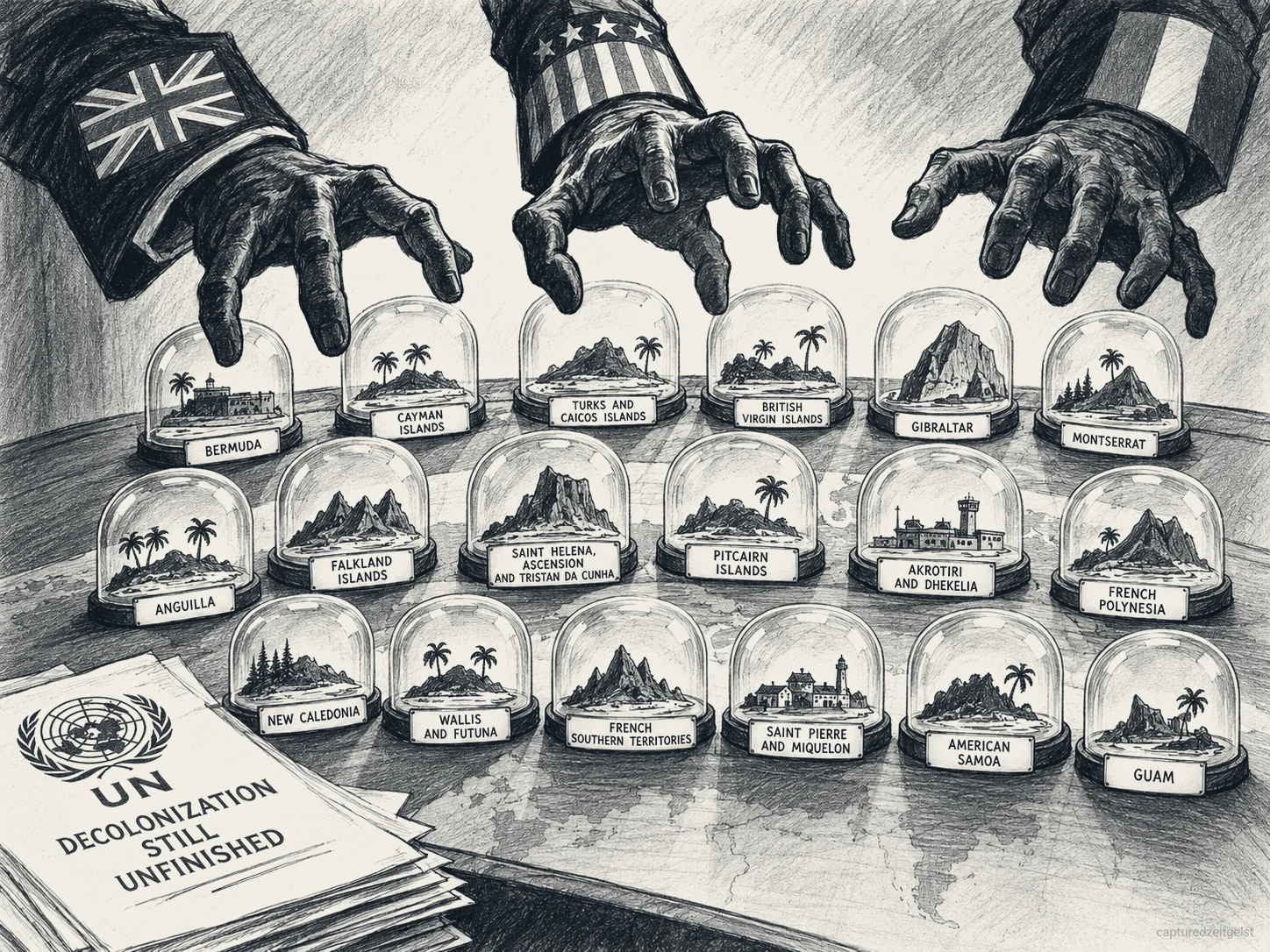
Seventeen rings, four capitals
Sort the votes by history
Every UN member, sorted by its colonial trajectory, with each named vote in its column. Hover or tap a name for its history; a dagger marks a contested coding. The grey squares are votes nobody can yet name. The trajectories follow the research dossier behind this essay and compress centuries into a tag, so read them as a starting point, not a verdict.
The columns are not equally complete. Every «no» is named, but fewer than one «yes» in three. Any chart that sets them side by side, including this one, makes the «no» side look larger than it is. Compare within a column, not across.
Five contested codings, and why we flag them+
China. Coded as never formally colonised, although Hong Kong, Macau and the treaty ports were under foreign rule.
Liberia. Coded as never formally colonised, although it was founded by the American Colonization Society and ruled for a century by a settler elite.
Ethiopia. Coded under occupation: Italy occupied it from 1936 to 1941, and Ethiopia was itself an expanding empire. Some historians treat the occupation as colonial rule.
Israel. Coded as a settler-colonial state. The characterisation is contested in scholarship and in politics.
Ireland. Coded as formerly colonised. Whether its relationship with Britain was colonial is debated by historians.
Recoding any one of them moves a single entry. None of them changes the alliance finding.
Every former overseas empire with a named vote voted no, except Russia, the sponsor. All four powers still administering listed territories voted no. Every one of them is also inside the EU, NATO or Washington's Pacific alliances, so here history and alliance cannot be separated.
Settler states split three ways: Australia, Canada and Israel against; Argentina and Chile abstaining; Brazil, South Africa and Uruguay reported in favour.
Seventeen of the forty nine «no» votes came from states shaped by continental empire or occupation, most of them once ruled or dominated from Moscow, and all of them now inside the EU, NATO or the EU queue. OPINIONTheir «no» is not imperial nostalgia. It is memory.
The formerly colonised sit in every column: Cuba, India, Egypt, Ghana and eleven others in favour; Korea, Sri Lanka, Morocco and eight others abstaining; Ireland, Cyprus, Malta and Micronesia against. And 77 of the 107 cannot yet be named at all. One news report records no vote for Nigeria.
The strongest case on each side
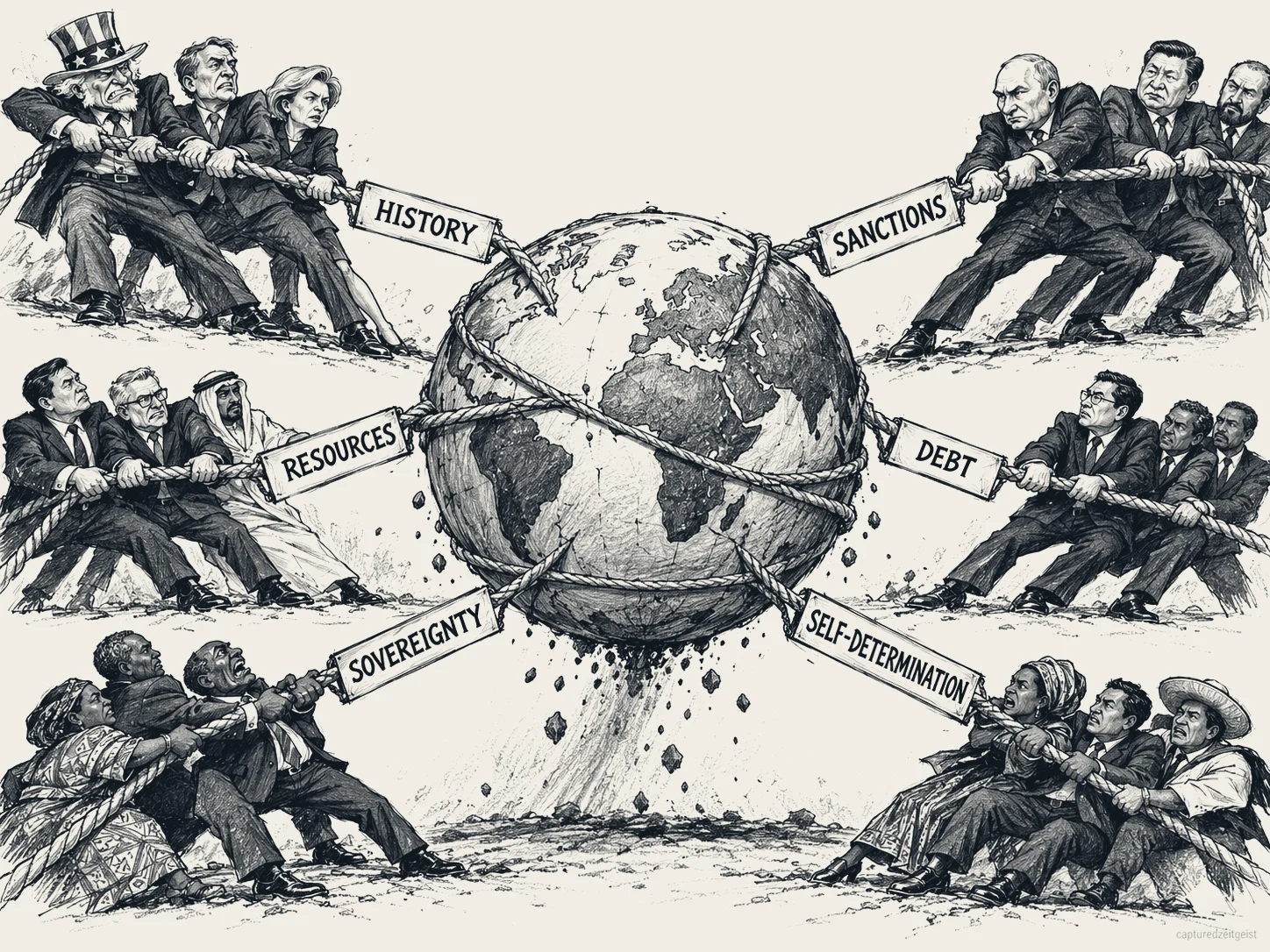
Before we judge the vote, here are the arguments as the states made them. Explanations of vote come from the meeting of 15 October; the other statements come from the debate that preceded it.
«A clear attempt by the Russian Federation to exploit politically the work of this committee.»
The text «stretches the concept of colonialism well beyond its legal and historical meaning».
«Colonialism must be brought to an end, everywhere.» Norway also recalled its own occupation, and its support for liberation in Zimbabwe and South Africa.
The focus «should have been the issue of recent attempts to acquire territory by force».
The sponsor described the evolution of colonial practices and presented the text as an alternative that encourages cooperation to reduce structural inequality.
Colonialism «is not a relic of the past».
«Colonialism did not end with the raising of flags.»
New forms include economic coercion, the manipulation of structural power in global finance and trade, and exploitative control over natural resources.
An «acute empathy» for those still under colonialism, because the work of decolonisation remains «unfinished».
The seventeen territories «represent individuals and peoples with hopes, dreams and aspirations».
There is no «statute of limitations» on self-determination.
We have not found an explanation of vote on this text from any African delegation. If you have one, send it to us.
OPINIONThe strongest case against is not that colonialism is over: Norway and Japan both say the opposite. It is that a text against force, sponsored by a state using force, cannot be taken at its word, and that folding sanctions into «colonialism» lets the sanctioned grade their own exam. The strongest case for is that the economic line of the genealogy is real, documented since Bandung and Nkrumah, and that the states most exposed to it are the least able to refuse it. Both cases survive contact with the evidence.
Three truths that refuse to cancel out
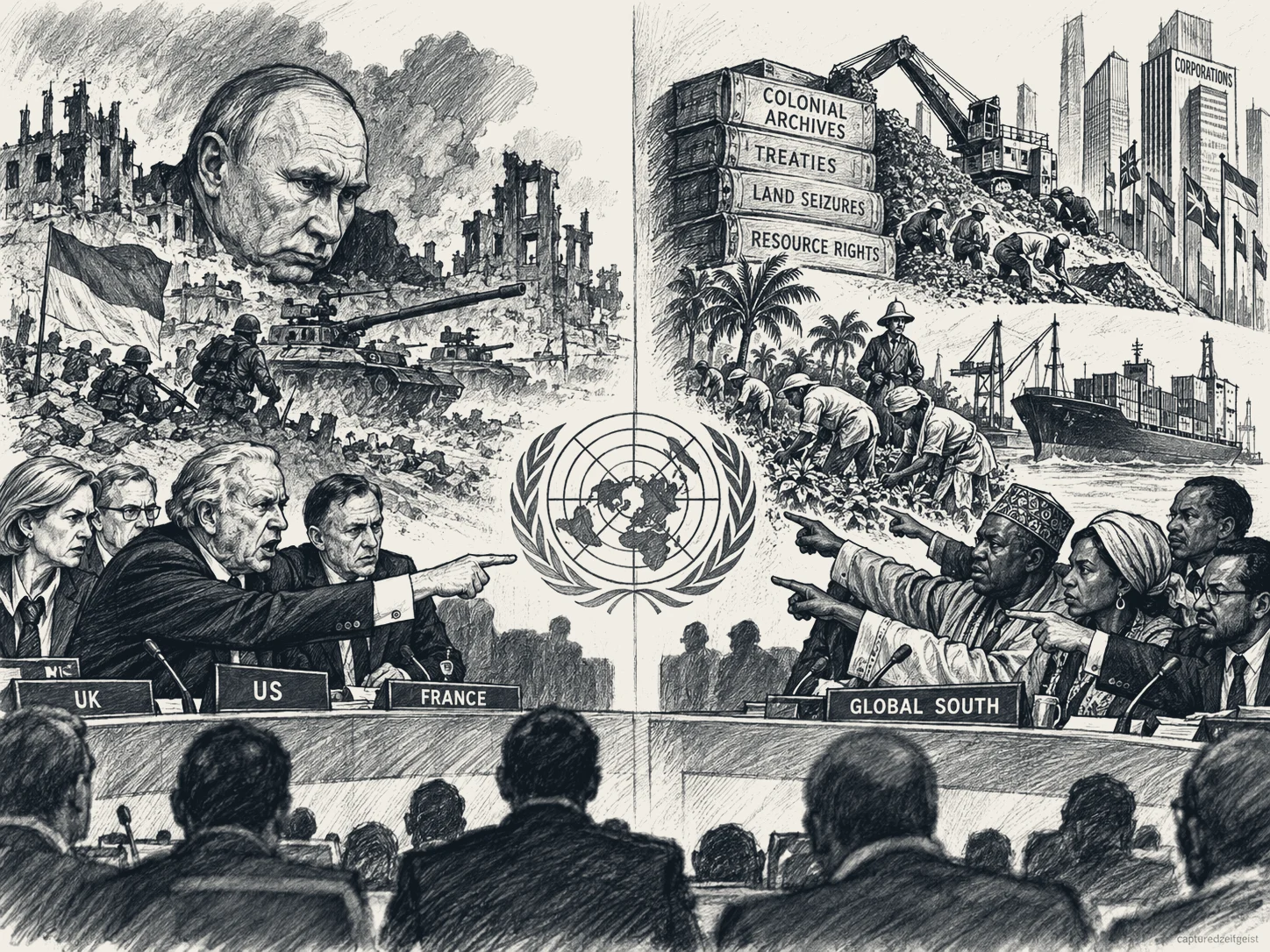
The sponsor of this text is fighting a war to take territory from a neighbour it once ruled. Ukraine's delegate called the draft «another attempt by Russia to present itself as a champion of decolonization», and defended sanctions on Russia as a legitimate response to aggression. A text against coercion, carried by a state at war, invites exactly that reply, and the reply deserves to be heard in full.
The states that voted no include those that still administer sixteen of the seventeen territories on the UN's own list; that hold, in the British Museum's case, the largest unreturned collection of Benin objects in the world; and whose currencies, sanctions and market rules are the constraints much of the world actually lives under. The same morning, the United States told the committee that the Special Committee on Decolonization «has outlived its original purpose».
The formerly colonised did not vote as a bloc. Korea, Sri Lanka, Morocco, Panama and Papua New Guinea abstained. Ireland, Cyprus and Malta voted no. A single «Global South position» did not survive the roll call either.
OPINIONThe mistake is to let any one of these cancel the others: to dismiss every complaint about economic coercion because Moscow voiced it, or to excuse Moscow's war because the complaint is real. What holds all three is what the dossier behind this essay calls actor-neutral standards: one definition of coercion, applied to everyone who coerces. A rule against unlawful unilateral measures that binds Washington and Brussels must bind Moscow and Beijing. A rule that protects sovereignty must protect Kyiv as firmly as Havana.
The significance of 85 to 49 to 23 lies in that collision of histories.
Colonialism without colonies, and a «no» from Bern
On the provisional record, Switzerland voted against. We joined the UN only in 2002, by popular vote, and we never held a colony. Historians describe our position as «colonialism without colonies»: Swiss merchants, banks, insurers, missionaries, scientists and trading houses took part in colonial and slavery-era networks without the Confederation ever raising a flag abroad. It is a scholarly frame, not a legal status. It is also exactly the kind of relationship a text about «contemporary forms» is trying to name.
Our record is not only one of denial. In 2021 eight Swiss museums formed the Benin Initiative Switzerland and researched, with Nigerian partners, the provenance of 96 objects from the Kingdom of Benin, more than half of them looted or probably looted by British troops in 1897. In March 2026 ownership of 28 objects passed to Nigeria. In June, 18 travelled home for a ceremony in Lagos; ten stay in Zurich and Geneva on loan, by agreement with their owners. OPINIONResearch first, ownership second, display on the owners' terms. That is what taking history seriously looks like in practice.
OPINIONAnd the position THE SHIFT № 002 traced through Geneva's commodity houses, pricing, financing, insuring and shipping other countries' resources, is precisely the kind of power this text describes. Not a flag, not a governor: leverage. We can think the Russian draft was the wrong vehicle and still take seriously the question it carries.
On 15 October sixteen delegations took the floor on this text, from the European Union and Norway to Japan and Saudi Arabia. Switzerland was not among them. Bern's reasons deserve to be asked for before the plenary vote.
What to watch before December
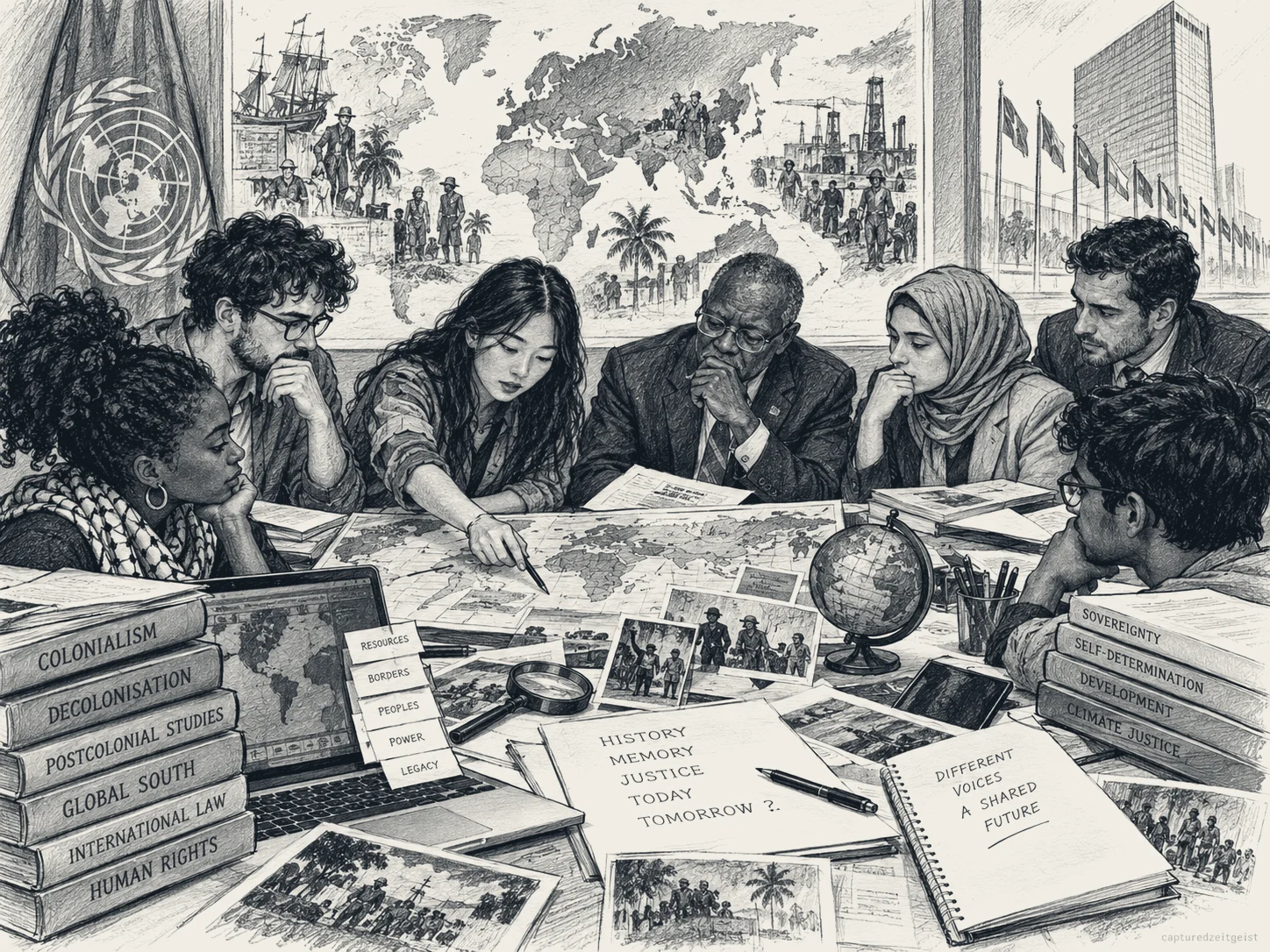
The draft goes to the General Assembly, normally in December. Watch whether the margin holds, and whether the 23 abstainers move.
When the UN publishes the country by country record, we will update every name on this page and mark each correction.
Forty seven African votes are not yet verifiable. For a diaspora readership it is the biggest gap in what we know, and the one most worth closing.
Whether anyone, sponsor or opponent, proposes a test of coercion that applies equally to all. That is the version of this resolution worth having.
OPINIONThe twentieth century settled one question: peoples should not be ruled as colonies by foreign powers. The twenty first is asking a harder one: whether sovereignty means anything when someone else can decide your currency, your market access, your technology and your credit. Eighty five states said that is still colonialism. Forty nine said it is something else. Our answer is that it depends on what is done, how, and under which rule, and never on who does it. That is the only position we know that can be asked of everyone, including ourselves.