The African Aramco Moment
Twenty billion dollars of steel on the Lekki coast. Four dollars to own a piece of it. And the bell rang in Lagos, not London.
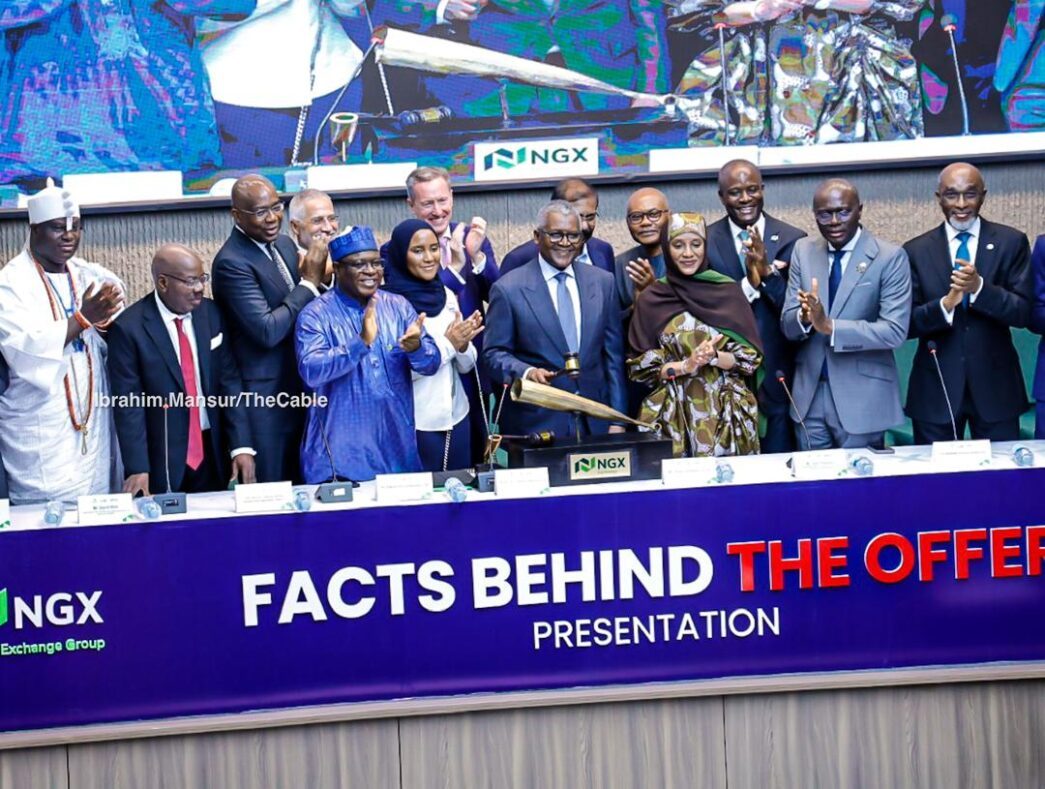
On 14 September 2026 Aliko Dangote opened the public offering of Dangote Petroleum Refinery and Petrochemicals on the Nigerian Exchange. Roughly 4.1 billion new shares at ₦525 each, targeting ₦2.15 trillion, about US$1.6 billion, rising toward US$2.1 billion if the greenshoe option is exercised. The minimum ticket is ten shares, close to four dollars. Dangote calls it a «people's IPO» and says the aim is to «democratise wealth creation».
The plant behind the paperwork cost about US$20 billion and took roughly a decade. It processes some 700,000 barrels a day, with an ambition of 1.4 million by 2029, which is top tier by any global measure. Since start up in 2024 Nigeria has moved from importing refined fuel to exporting it. Renaissance Capital Africa analysts call the refinery «a systemically important institution for the nation».
None of that is the shift. The shift is where the shares were sold. An asset this size would conventionally seek capital in London or New York, arranged by international banks and owned by global institutions. Dangote went to Lagos first, and says a secondary listing in the United States might follow in three or four years. The order of those two sentences is the entire argument.
The plant already refines more than the country consumes, which is the whole export logic: capacity built past the domestic market on purpose. Domestic demand is an approximate order of magnitude, reported figures vary by season and by how much fuel crosses borders informally.
One asset, measured three ways
Pick a view, then click any bar. The plain language reading updates underneath. No finance vocabulary required, and every number carries its source.
Five rules being broken at once
{{ w.h }} READ
Switzerland does not disappear from that second column. Geneva still finances, hedges, insures and markets the barrels. Its position in the chain simply moves from owning the import trade to servicing an African producer. S&P Global recorded West African clean product imports falling 23 per cent in a single month as the refinery ramped up, with tanker ton miles falling sharply because the fuel no longer travels from Europe and the Middle East.
The room, and why each seat counts
WHY THIS SEAT COUNTS
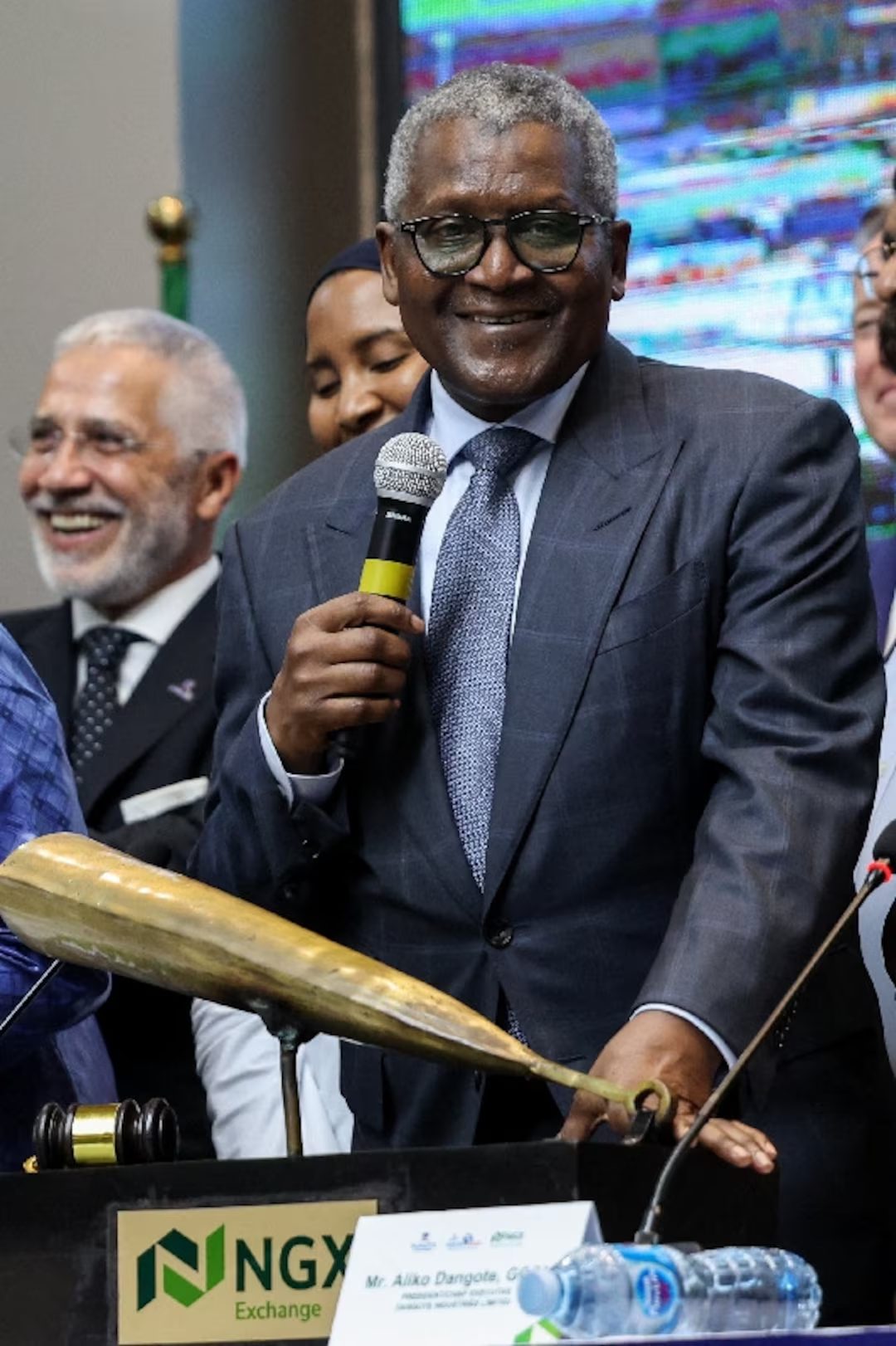
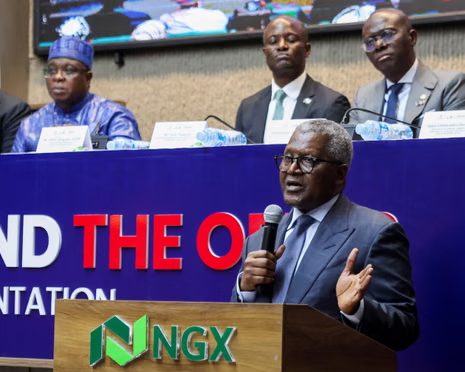
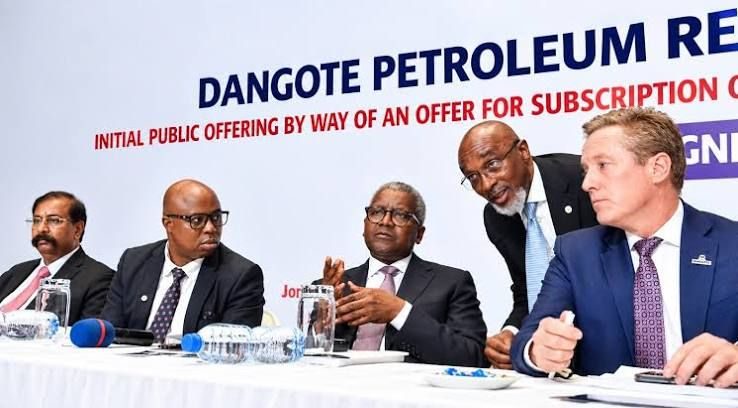
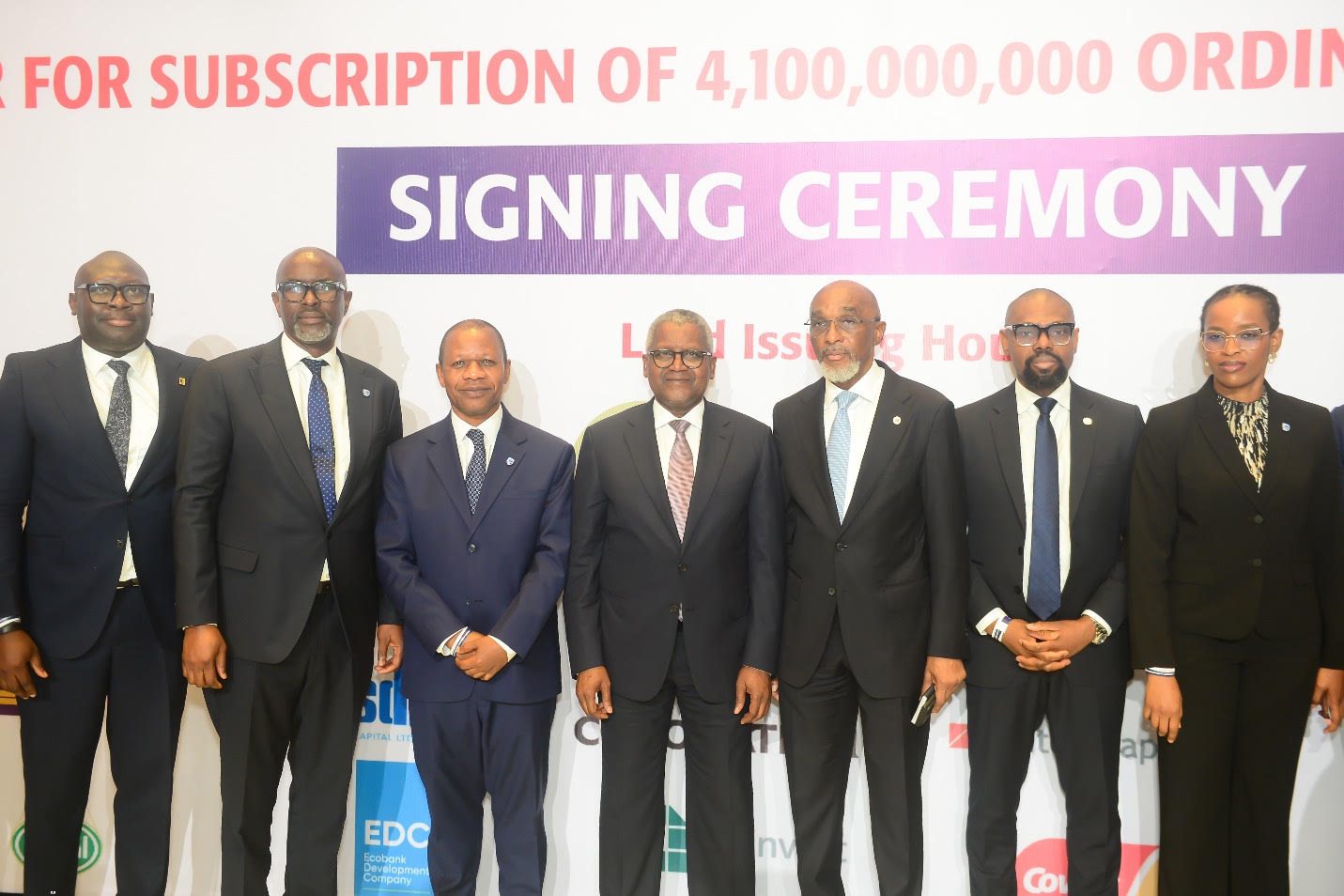
Born in Kano in 1957 into a trading family, Dangote began by importing commodities and then spent four decades doing the opposite: building the plants that make what Nigeria used to buy abroad. Cement, sugar, salt, flour, fertiliser, and now petroleum products. He is Africa's richest person and the head of one of the continent's largest industrial groups.
His method is consistent. Identify a product the country imports at scale, build capacity larger than the domestic market needs, and export the surplus. The refinery is that method at its most extreme, financed privately through a decade of construction delays and currency crises before a single share was sold to the public.
At the exchange he said he intends eventually to list every company in the group. Bloomberg's Next Africa newsletter argued in June that a refinery IPO of this size «could rewrite funding models» for the continent. That claim is now being tested in public.
Has an African billionaire done this before?
Owning a listed company is not the same as using a public offering to turn privately built industrial infrastructure into an asset ordinary citizens can hold. On that narrower test the field thins quickly. The transactions below are documented fact. The scores are our judgement, and we say so.
WHAT HAPPENED
Three conclusions follow. Dangote did not invent the African billionaire offering: Masiyiwa listed Econet three months after launch in 1998 and made everyday Zimbabwean investors the point of it, Motsepe used the JSE in 2002 to shift mining ownership, and Naguib Sawiris proved an African founded infrastructure company could reach multinational scale on public equity.
Second, several fortunes that look comparable are not. BUA Cement arrived through a merger of existing companies, BUA Foods through a listing by introduction, which makes existing shares tradable without selling new ones. Dangote Cement itself came to market in 2010 through a merger with Benue Cement rather than a primary raise. What is different today is new shares, new public money, financing the next phase.
Third, the direction of travel separates the models. Samih Sawiris moved his holding company to Altdorf and listed Orascom Development on the Swiss exchange in 2008 to reach international capital, and the shares later disappointed badly enough that the company was heading off SIX by 2025. Nassef Sawiris took OCI to Amsterdam. Nicky Oppenheimer went the other way entirely and took De Beers private in 2001. Dangote is the rare case of keeping the flagship anchored at home and asking foreign money to come to him.
Two truths, held at the same time
Most industrial champions anywhere, from Korean chaebol to American defence contractors, grew through complicated relationships with their states. The useful question is not whether the state helped, but whether the help produced competitive productive capacity or merely protected rent. On the first test the refinery is doing something real. On governance, selling three per cent while retaining overwhelming control broadens participation rather than sharing power. Those are different achievements, and only one of them was announced today.
Four structural risks, in plain language
Every word with a dotted underline explains itself if you hover over it, or tap it on a phone. No economics degree required, because none of this should be understandable only to people who already own shares.
One dependency traded for another EXPLAIN
The liquidity trap on a single exchange EXPLAIN
A valuation that has to be earned every quarter EXPLAIN
The Swiss desks are not removed, they are repositioned EXPLAIN
Reported in this section: Premium Times on the expansion's dependence on crude supply, African Markets and CNBC Africa on the ₦2.15 trillion offer and the possible United States secondary listing, Olaniwun Ajayi's Nigeria oil and gas outlook on upstream friction, and Mondaq on hedging practice among Nigerian oil and gas firms. Judgement and framing are ours.
«But the world is moving to renewables»
It is the first objection raised in Zurich and the last one raised in Lagos. It deserves better than either dismissal or applause, so here it is against the peer reviewed record. Each row states the objection, then what the published evidence actually supports, with the citation attached.
Where does that leave the refinery? On the historical accounting, the case that Africa is owed development space is strong and quantified in the literature, not merely rhetorical. On the asset itself, the same literature is the reason for caution rather than comfort: the studies that establish who caused the problem also establish that late built fossil capacity is where the losses land. Both findings come from the same body of work, and taking one without the other is not evidence based, it is selection.
Our reading, stated as judgement: the strongest developmental defence of Lekki is not that oil has a long future. It is that the plant captures value from a resource Nigeria is extracting anyway, that refined product demand in Africa is still rising while European refineries close, and that the petrochemical line feeding regional manufacturing outlives the fuel line. The weakest defence is the one most often heard, that the West industrialised on coal so Africa may industrialise on oil without reckoning with a 2040s balance sheet. The first argument survives scrutiny. The second is a moral claim wearing an investment case.
The event, in moving pictures
If you want the whole story rather than the headline, this recorded talk is the most entertaining way in. Worth the time before forming an opinion on the share price.
Interesting fact: how many Nigerians live in Switzerland? OPEN
According to official Swiss figures, 2,531 Nigerian citizens were resident in Switzerland at the end of 2024, and 271 Swiss citizens were living in Nigeria. Most of the Nigerian community lives in the larger cities: Zurich, Geneva, Bern and Biel. The two countries also maintain a migration partnership covering cooperation on migration questions.
Context, not decoration: a «people's IPO» priced at four dollars a ticket is, in principle, reachable from Zurich or Biel as well as from Lagos. Whether it actually is depends on broker access and currency rules, which is the practical question in the section above.
Fourteen words that do the work
Open the glossary, fourteen terms in plain wordsOPEN
Africa does not lack billionaires. It lacks billionaire built institutions that outgrow the billionaire. Today was a step toward one, taken by a man who still controls it.